
Sunbeam 1000hp Stars and Stripes
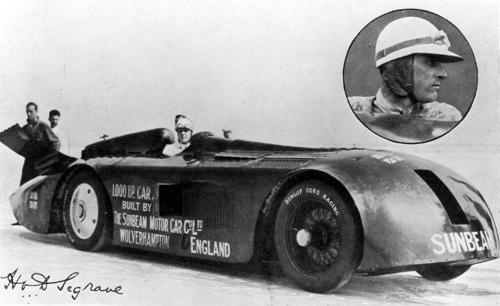
A highly visible aspect of the Henry Segrave’s Sunbeam 1000hp is the use of the crossed national flags – displayed as a courtesy to the record attempt’s host country - on the car’s front bodywork. This does, sometimes, cause confusion amongst those perhaps seeing the car for the first time into thinking that the Sunbeam is a product of the USA rather than Wolverhampton in the West Midlands of England!
It is entirely possible that the display of these national symbols of the UK and the USA was the first time that such a motif was used on a land speed record car as opposed to individual national flags (Malcolm Campbell used a single Union Flag on each side of the Sunbeam 350hp Blue Bird for instance).
The Sunbeam 1000hp was effectively the first time that a specifically organised attempt to set an outright World Land Speed Record attempt with a British car in America – as opposed to participating in a general speed event - had been made. John Cobb’s Railton Special, a long-time resident of the Birmingham Science Museum (now Think Tank), also used the crossed-flags – with the Union Flag on the right when viewed from the front - when setting new records at Bonneville in 1938 and 1939, and again in 1947.
George Eyston’s Thunderbolt (lost in a warehouse fire in New Zealand in 1946 but possibly buried under part of Wellington Airport), that ran concurrently with the Railton in 1938/39 made do with a single Union flag on the tail section. This was also the case with Segrave’s Golden Arrow in 1929.


The earlier land speed records from 1898 were achieved, mostly in the car's and driver’s country of origin so did not carry national identification or there is no evidence that anything other than a single national flag was displayed.
The Blue Bird car of Sir Malcolm Campbell followed the Sunbeam practice of incorporating both flags from 1928 through to the final iteration of the car in 1935 and that is how the car is displayed today at the Motorsports Hall of Fame of America in Daytona Beach.
On turning to the world of water speed records, Sir Malcolm Campbell displayed the relevant national flags on the nose of Bluebird K3 in 1937/38 and the Bluebird CN7 of Donald Campbell does, of course, continue the tradition featuring the Australian flag from 1964 (CN7 did, of course, carry the stars and stripes during its unsuccessful attempt at Utah in 1960).

Proteus Bluebird CN7 - National Motor Museum
On the Sunbeam 1000HP, the "stars and stripes" has, correctly of course, 48 stars as Alaska (joined January 1959) and Hawaii (joined August 1960) had yet to be officially admitted to the Union. As for the (British) Union Flag, there is always a slight issue when viewing the flag when it is displayed on the left as it can give the impression of being upside down. The rule is that the broad white band on the top (i.e. near the flagpole) is only on the left when there's no pole. So, perhaps, John Cobb was trying to avoid this, by having the flags the other way round, with the Railton Special.
The links between the United Kingdom and the United States in connection with the Sunbeam 1000hp do, however, go much deeper that the display of national flags.
Henry O’Neal de Hane Segrave was born on the 22nd September 1896 in Baltimore, Maryland, USA. His father, Charles Segrave, was at that time Assistant Consul to the British Consular Service in Baltimore. His mother, Mary Lucy Harwood was from a prominent Baltimore family. She was born in the City of Baltimore on the 1st May 1867 and died on the 27th August (aged 31) at Chattolanee in Baltimore County. She was the daughter of James K. Harwood, formerly of the United States Navy, and a granddaughter of the Right Revd. James Kemp, bishop of Maryland. Her mother was a daughter of Judge Glenn, of Maryland. Charles and Mary Segrave were married in April 1893.
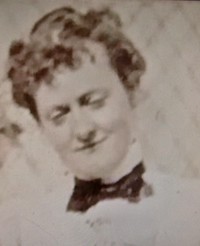
Henry Segrave was the couple’s only child. Charles Segrave was born in Wolverhampton where his father, also Henry Segrave, had served in the Crimean War as a Captain and had latterly become Chief Constable of Wolverhampton serving from 1857 to 1878. He subsequently moved the family to Ireland where he had inherited his brother’s estate in County Wicklow. Named Henry after his grandfather, O’Neal after his Irish forebears, and de Hane (always called as such within his family) after his paternal grandmother who was a descendent of one of France’s oldest Huguenot families. After Mary Segrave’s death in 1898, the following year Charles returned to Europe and eventually married for a second time in 1901. Young Henry was brought up in Ireland and seems to have been influenced at an early age by mechanical transport as his father had bought one of the first cars in Ireland. He was initially educated at home before eventually enrolling at the prestigious Eton College in 1910.
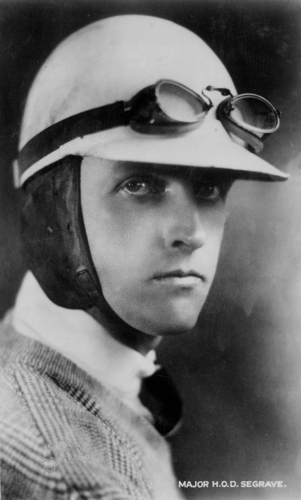
Just four years later came the First World War and Henry joined the Sandhurst officer training course being commissioned in November and joined the Royal Warwickshire Regiment with the rank of Lieutenant. He was wounded twice in close combat during 1915 he recuperated in England where he transferred to the Royal Flying Corps. In early July 1916 his aircraft was hit by ground fire over the Somme and crashed resulting in Henry breaking an ankle that ended his combat flying.
In early 1918, Segrave was assigned to the Munitions Inventions Department' and was then sent to the USA in the autumn as part of the HQ Staff on the British Aviation Mission. The RFC had been merged in 1918 with the Royal Naval Air Service to form the Royal Air Force.
In June of that year, Henry and his wife Doris Stoker (they had married on 4 October 1917), a well-known actress in musical theatre, departed for the United States following his promotion to the rank of Major as part of Britain’s Aviation Mission to Washington based in the British Embassy. He and his wife returned to Britain soon after the Armistice in November 1918.
After the war, he transferred to the Royal Air Force Administrative Branch in 1919 but soon resigned his commission due to his war injuries.
Segrave had bought a series of relatively high performance cars over the years and naturally became interested in taking up motor racing. When he won the 1923 French Grand Prix in a Sunbeam, he became the first Briton to win a Grand Prix in a British car and in 1924 he also won the San Sebastian Grand Prix in Spain and soon afterwards he retired from racing to concentrate on speed records.
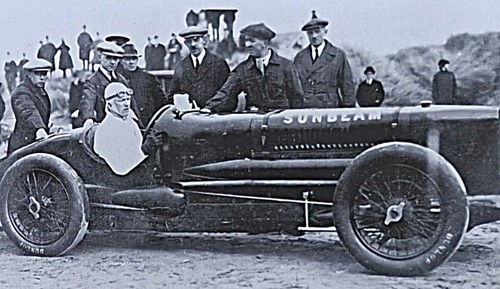
Segrave’s first land speed record was set by him on 16th March 1926, at 152.33 miles per hour, with the 4 litre V12 Sunbeam on Ainsdale beach at Southport. Then came the first of his two visits to Daytona where he became the first person to travel over 200 mph driving the Sunbeam 1000HP where he recorded a speed of 203.79 miles per hour on the 29th March 1927.
Two years later, on 11th March 1929, also at Daytona Beach, Segrave set his final land speed record, using a new car designed for him by Captain Jack Irving and named the Golden Arrow setting a new record of 231.45mph.
On his return to Britain, he was knighted – at Bognor Regis - by HM King George V on the 27th May. He never attempted another land speed record.
Henry Segrave then turned his attention to the world water speed record and had previously raced a variety of boats in international competition whilst pursuing his land speed record activities. He became the first person to hold both titles simultaneously although his successful record came with tragedy.
Piloting Miss England II, powered by two Schneider Trophy Rolls-Royce R Type engines, Segrave was killed in an accident on the 13th June 1930 on Windermere in the English Lake District shortly after setting a new world water speed record of 98.76 mph. The boat had a crew of three and engineer Victor Halliwell also died in the crash when the boat capsized.
In 1930 the Segrave Trophy was established by Lady Doris Segrave and is awarded by the Royal Automobile Club to recognise any British national who demonstrated the most outstanding accomplishments in the possibilities of transport by land, sea, air, or water. Recent recipients includes the current holder of the world land speed record, Andy Green.
The Sunbeam 1000hp is on exhibition at the world-renowned Petersen Automotive Museum in Los Angeles until early 2027.
Feature by Ian Robinson, Volunteer at the National Motor Museum.